Why AI needs to work for Teams, not just individuals
Why AI needs to work for Teams, not just individuals
A reflection on how AI is currently being used in isolation within product teams, and why the future lies in creating shared context and collaborative thinking. Based on insights from a Miro roundtable in Copenhagen about aligning on problems, making thinking visible, and using AI as team infrastructure rather than individual copilots.
Reflections

Digital artwork by Frank Ocean and Sango
I realized yesterday how differently AI is being used in teams. Most of the time, it's still very individual. People using AI on their own to think faster, write faster, decide faster.
But most product problems aren't individual problems. They're shared ones.
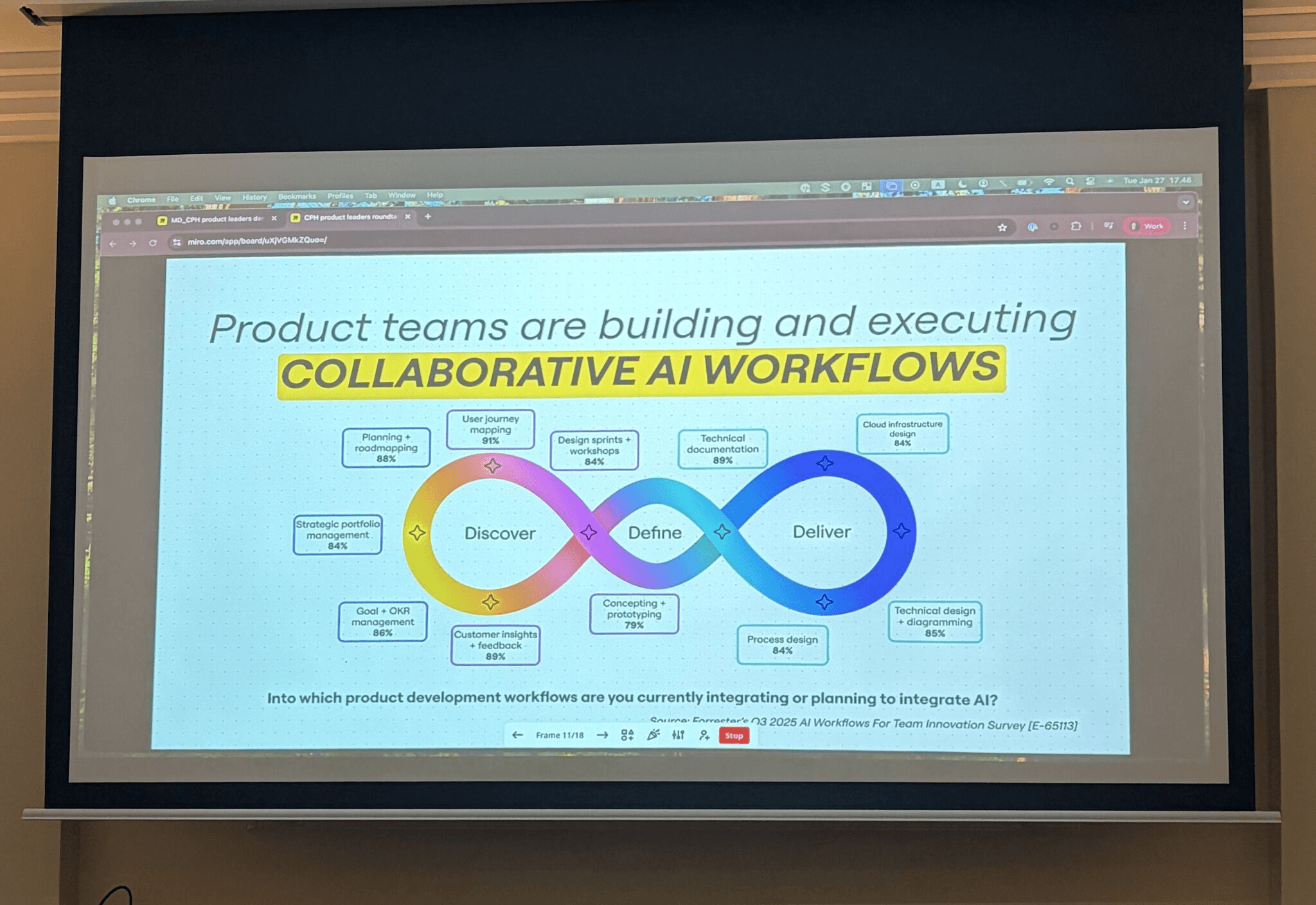
That was the interesting part of yesterday's Miro roundtable in Copenhagen. We talked about how we each use AI today, where it already breaks down, and what needs to be in place for it to be useful.
That last part really clicked for me as a visual thinker. I rely heavily on seeing things—flows, relationships, assumptions. Visual tools help with this, but only up to a point. If the underlying data or context isn't clear or shared, there's only so much you can do.
What I appreciated most was the focus on the premise. Before any tool or AI can help, teams need alignment on some basic questions:
Are we aligned on the problem?
Are we looking at the same information?
Is the thinking visible to everyone involved?
How do we co-create prompts in one place?
When these conditions are true, tools like Miro help teams think and prompt together. AI then becomes support—helping to organize, summarize, and surface patterns—instead of something everyone uses in isolation, creating parallel versions of understanding that never quite converge.
The shift isn't about using better AI models. It's about creating the conditions where AI can support collective intelligence rather than just individual productivity.
This means:
Shared context, not private chats
Visible reasoning, not black-box outputs
Co-created prompts, not individual queries
Tools that facilitate thinking together, not just thinking faster
These were the kinds of conversations you don't get very often. Practical, honest, and focused on real problems rather than hypothetical possibilities.
The future of AI in product work isn't about replacing human judgment. It's about building systems where teams can think together more effectively, with AI as infrastructure rather than as individual copilots pulling people in different directions.
That's the work worth doing.

Sign up to my super cool newsletter!
More to Discover


Why AI needs to work for Teams, not just individuals
Why AI needs to work for Teams, not just individuals
A reflection on how AI is currently being used in isolation within product teams, and why the future lies in creating shared context and collaborative thinking. Based on insights from a Miro roundtable in Copenhagen about aligning on problems, making thinking visible, and using AI as team infrastructure rather than individual copilots.
Reflections
Digital artwork by Frank Ocean and Sango
I realized yesterday how differently AI is being used in teams. Most of the time, it's still very individual. People using AI on their own to think faster, write faster, decide faster.
But most product problems aren't individual problems. They're shared ones.
That was the interesting part of yesterday's Miro roundtable in Copenhagen. We talked about how we each use AI today, where it already breaks down, and what needs to be in place for it to be useful.
That last part really clicked for me as a visual thinker. I rely heavily on seeing things—flows, relationships, assumptions. Visual tools help with this, but only up to a point. If the underlying data or context isn't clear or shared, there's only so much you can do.
What I appreciated most was the focus on the premise. Before any tool or AI can help, teams need alignment on some basic questions:
Are we aligned on the problem?
Are we looking at the same information?
Is the thinking visible to everyone involved?
How do we co-create prompts in one place?
When these conditions are true, tools like Miro help teams think and prompt together. AI then becomes support—helping to organize, summarize, and surface patterns—instead of something everyone uses in isolation, creating parallel versions of understanding that never quite converge.
The shift isn't about using better AI models. It's about creating the conditions where AI can support collective intelligence rather than just individual productivity.
This means:
Shared context, not private chats
Visible reasoning, not black-box outputs
Co-created prompts, not individual queries
Tools that facilitate thinking together, not just thinking faster
These were the kinds of conversations you don't get very often. Practical, honest, and focused on real problems rather than hypothetical possibilities.
The future of AI in product work isn't about replacing human judgment. It's about building systems where teams can think together more effectively, with AI as infrastructure rather than as individual copilots pulling people in different directions.
That's the work worth doing.
Sign up to my super cool newsletter!
More to Discover
Why AI needs to work for Teams, not just individuals
Why AI needs to work for Teams, not just individuals
A reflection on how AI is currently being used in isolation within product teams, and why the future lies in creating shared context and collaborative thinking. Based on insights from a Miro roundtable in Copenhagen about aligning on problems, making thinking visible, and using AI as team infrastructure rather than individual copilots.
Reflections
Digital artwork by Frank Ocean and Sango
I realized yesterday how differently AI is being used in teams. Most of the time, it's still very individual. People using AI on their own to think faster, write faster, decide faster.
But most product problems aren't individual problems. They're shared ones.
That was the interesting part of yesterday's Miro roundtable in Copenhagen. We talked about how we each use AI today, where it already breaks down, and what needs to be in place for it to be useful.
That last part really clicked for me as a visual thinker. I rely heavily on seeing things—flows, relationships, assumptions. Visual tools help with this, but only up to a point. If the underlying data or context isn't clear or shared, there's only so much you can do.
What I appreciated most was the focus on the premise. Before any tool or AI can help, teams need alignment on some basic questions:
Are we aligned on the problem?
Are we looking at the same information?
Is the thinking visible to everyone involved?
How do we co-create prompts in one place?
When these conditions are true, tools like Miro help teams think and prompt together. AI then becomes support—helping to organize, summarize, and surface patterns—instead of something everyone uses in isolation, creating parallel versions of understanding that never quite converge.
The shift isn't about using better AI models. It's about creating the conditions where AI can support collective intelligence rather than just individual productivity.
This means:
Shared context, not private chats
Visible reasoning, not black-box outputs
Co-created prompts, not individual queries
Tools that facilitate thinking together, not just thinking faster
These were the kinds of conversations you don't get very often. Practical, honest, and focused on real problems rather than hypothetical possibilities.
The future of AI in product work isn't about replacing human judgment. It's about building systems where teams can think together more effectively, with AI as infrastructure rather than as individual copilots pulling people in different directions.
That's the work worth doing.
Sign up to my super cool newsletter!